
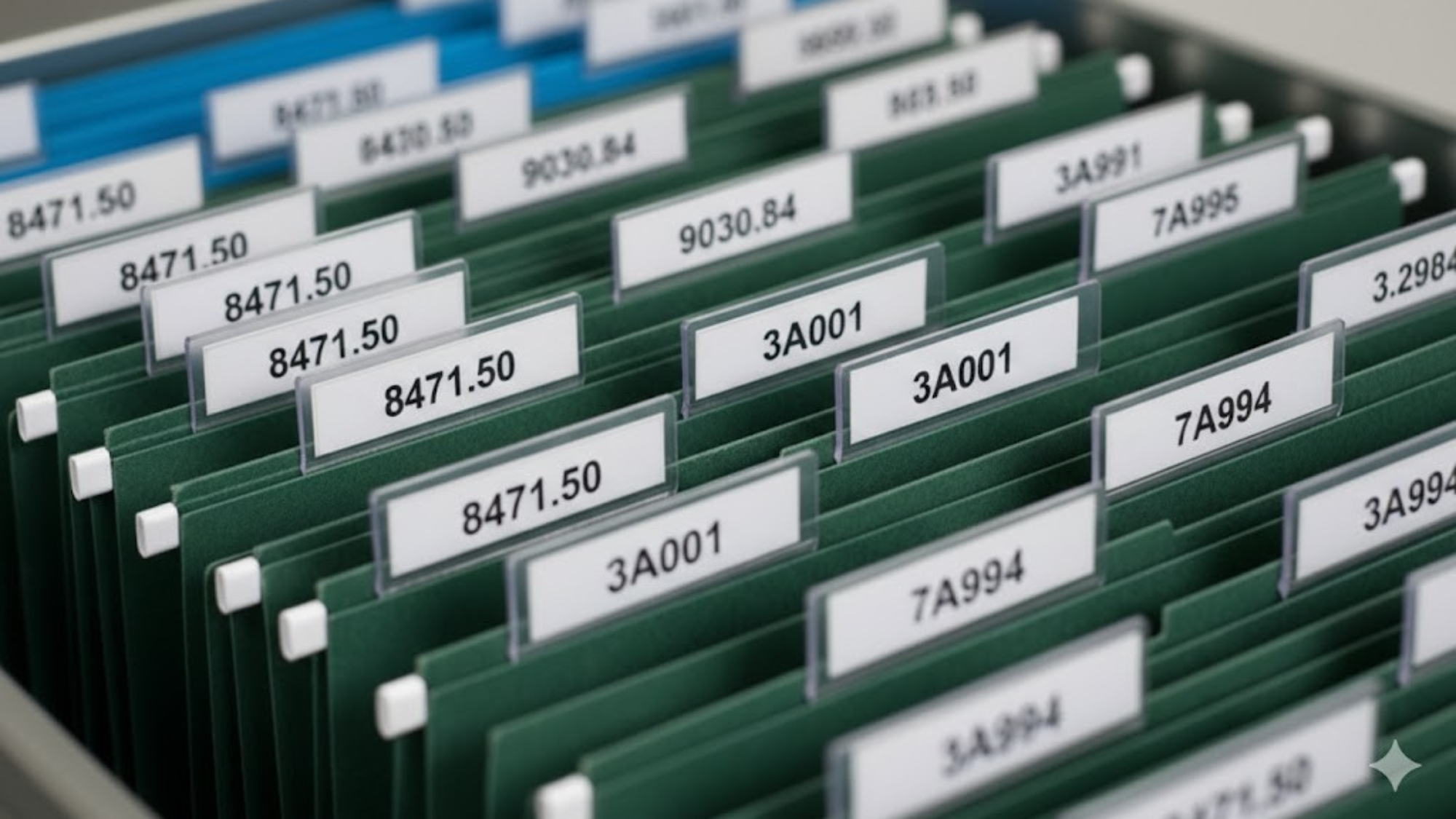
In the world of technology exports, one acronym appears regularly: ECCN. Behind these four letters lies the Export Control Classification Number, a code that determines whether a product, software, or technology is subject to specific controls and export licenses.
Born from U.S. regulations, the ECCN has now become a universal language of export compliance. Even European or Asian companies often need to know it, whether to work with U.S. partners, be part of an international supply chain, or simply secure their trade flows.
This article aims to give you a comprehensive overview of ECCN:
- What it is and why it matters
- What its origin and scope are
- How to determine it
- How it differs from other codes such as the HS Code or the USML
- What consequences it has for your exporting business
The goal is to give you a clear and structured view of the role of ECCN in export compliance.
What is an ECCN?
An ECCN (Export Control Classification Number) is a classification code used to identify goods, software, and technologies subject to the Export Administration Regulations (EAR), administered by the Bureau of Industry and Security (BIS) in the United States.
In practice, the ECCN helps answer a simple question:
👉 Can my product be exported freely, or do I need to obtain an export license?
The ECCN is not just an administrative code: it reflects the degree of technological and strategic sensitivity of a product.
Types of items covered
- Physical items: electronic components, telecommunication equipment, sensors, space systems, drones, etc.
- Software: encryption programs, cybersecurity applications, navigation systems.
- Technology: technical know-how, documentation, design data.
👉 In other words, ECCN covers the full spectrum of exportable technologies.
Origin and regulatory framework of ECCN
U.S. foundation
Historically, ECCN is a U.S.-specific tool embedded in the EAR. Its initial objective was to protect national security by controlling the spread of sensitive technologies (nuclear, cryptography, space, etc.).
International use
Even though ECCN remains a U.S. instrument, it is now used far beyond U.S. borders:
- European companies use it in their trade with the United States.
- Multinationals require their subsidiaries to classify their products with an ECCN.
- International contracts often require the ECCN of the product to be communicated.
Thus, ECCN has become a common language of export compliance, whether you are based in Paris, Tokyo, or Bangalore.
Why is ECCN so important?
Identifying required licenses
Knowing the ECCN makes it possible to determine whether a product requires a license to be exported to a given country.
Avoiding sanctions and delays
A classification error can have serious consequences:
- High financial penalties.
- Goods blocked in customs.
- Loss of trust from business partners.
Structuring internal compliance
Determining the ECCN is part of a broader Internal Compliance Program (ICP) for export controls.
ECCN vs other classification systems
ECCN vs HS Code
- HS Code: customs and tariff classification.
- ECCN: export and security classification.
A single product can have both an HS Code and an ECCN, but they are used for very different purposes.
ECCN vs USML
- ECCN: so‑called “dual‑use” items (civil/military).
- USML (United States Munitions List): strictly controlled military equipment under ITAR.
👉 This distinction is essential for aerospace and defense companies.
ECCN vs European classification
In Europe, Regulation (EU) 2021/821 on dual‑use items does not use ECCN but a common EU control list. However, in practice, many European companies still use ECCN in order to communicate effectively with U.S. partners.
How to determine your ECCN? (general overview)
Determining the ECCN is based on a structured method:
1. Collect technical information
Gather performance data, intended uses, and integrated components.
2. Identify the product category
Place the product in the correct “technology family” (software, electronics, space, etc.).
3. Check control criteria
Compare product performance with the thresholds in the regulations (encryption strength, resolution, power, accuracy, etc.).
4. Confirm whether an ECCN exists
- If the product matches an entry → a specific ECCN applies.
- If not → generic classification as “EAR99” on the U.S. side, or “not listed” in Europe.
5. Document the process
Record the criteria used, the sources consulted, and keep an auditable trail.
👉 For a detailed step‑by‑step guide, see the article “How to determine my ECCN code”.
Concrete application examples
Example 1 – Cybersecurity software
A European publisher sells an encryption solution.
- From a U.S. perspective, this software falls under an ECCN related to encryption.
- Even in Europe, the partner will often require that this code be communicated.
Example 2 – High‑resolution camera
An imaging sensor exported to Asia.
- Depending on resolution and performance, the camera will be classified under a specific ECCN.
- The U.S. customer uses this code to validate the export.
Example 3 – Standard mechanical part
A supplier of generic aeronautical parts.
- Non‑sensitive product → no specific ECCN (classified as EAR99).
- A documented analysis serves as evidence of due diligence in case of an audit.
Common mistakes to avoid
- Confusing ECCN and customs code.
- Copying a competitor’s ECCN without verification.
- Ignoring the impact of integrated components.
- Failing to document the classification process.
- Forgetting that ECCNs evolve as regulations are updated.
When to seek external support?
- Simple cases: the company can classify products internally.
- Complex cases: cryptography, space, dual‑use items → consult an external expert.
- Official tool: in the United States, it is possible to request a CCATS (Commodity Classification) from BIS.
👉 In Europe, national authorities can also be contacted for guidance.
Practical consequences of ECCN classification
- Contracts: many agreements require the ECCN to be specified.
- Customs: even though it is not strictly a customs data item, some authorities may request it.
- Partners: integrators, customers, and subcontractors systematically ask for the ECCN.
- Brand image: clear classification reinforces the company’s credibility.
ECCN and export compliance strategy
ECCN is a risk management tool within a broader compliance policy:
- Identifying sensitive goods and technologies.
- Controlling flows of data and equipment.
- Training internal teams.
- Communicating effectively with authorities.
In summary
ECCN is far more than a simple regulatory code. It has become a universal language of export compliance, used in the United States, Europe, and worldwide.
For companies, determining the ECCN of their products is:
- A guarantee of legal security.
- A contractual requirement.
- A lever for credibility with partners.
- ECCN is essential to determine whether an export license is required.
- Its determination relies on a rigorous and well‑documented method.
- Its use goes far beyond U.S. borders and directly concerns European companies.
💡 Do you want to secure your exports and clarify the ECCN classification of your products?
At Borie Conseils Exports, we support companies in identifying, documenting, and securing their export compliance, taking into account U.S., European, and local regulations. Contact us to find out more.
FAQ – All about ECCN
What is an ECCN?
An ECCN (Export Control Classification Number) is a classification code used to determine whether a product, software, or technology is subject to specific export controls. It is defined in U.S. regulations (EAR), but is now used internationally as a reference for export compliance.
What is the difference between ECCN and customs code (HS Code)?
- The HS Code is used to calculate customs duties and manage tax formalities.
- The ECCN is used to identify export license obligations related to security and the control of sensitive technologies.
👉 A product will often need both an HS Code and an ECCN.
How do I know if my product is “EAR99”?
A product is classified as EAR99 when it does not correspond to any specific ECCN entry. This means it is not listed as sensitive, but it may still be subject to certain restrictions (for example, in case of an embargo or prohibited destination). The analysis must be documented to justify this choice.
Does ECCN also apply to Europe?
Yes, indirectly. The European Union applies its own regulation (Regulation (EU) 2021/821 on dual‑use items), but many European companies use ECCN:
- To work with U.S. partners.
- To meet contractual requirements.
- To ensure consistency within international supply chains.
What should I do if I do not know my product’s ECCN?
You have several options:
- Follow an internal classification process (technical analysis + comparison with official lists).
- Request an official decision (CCATS from BIS in the United States).
- Consult an export compliance expert to secure the analysis and avoid costly mistakes.